Showing posts with label tatami mats. Show all posts

Tuesday, January 29, 2013

Cooking in Anna's Japanese Kitchen


COOKING IN ANNA'S JAPANESE KITCHEN

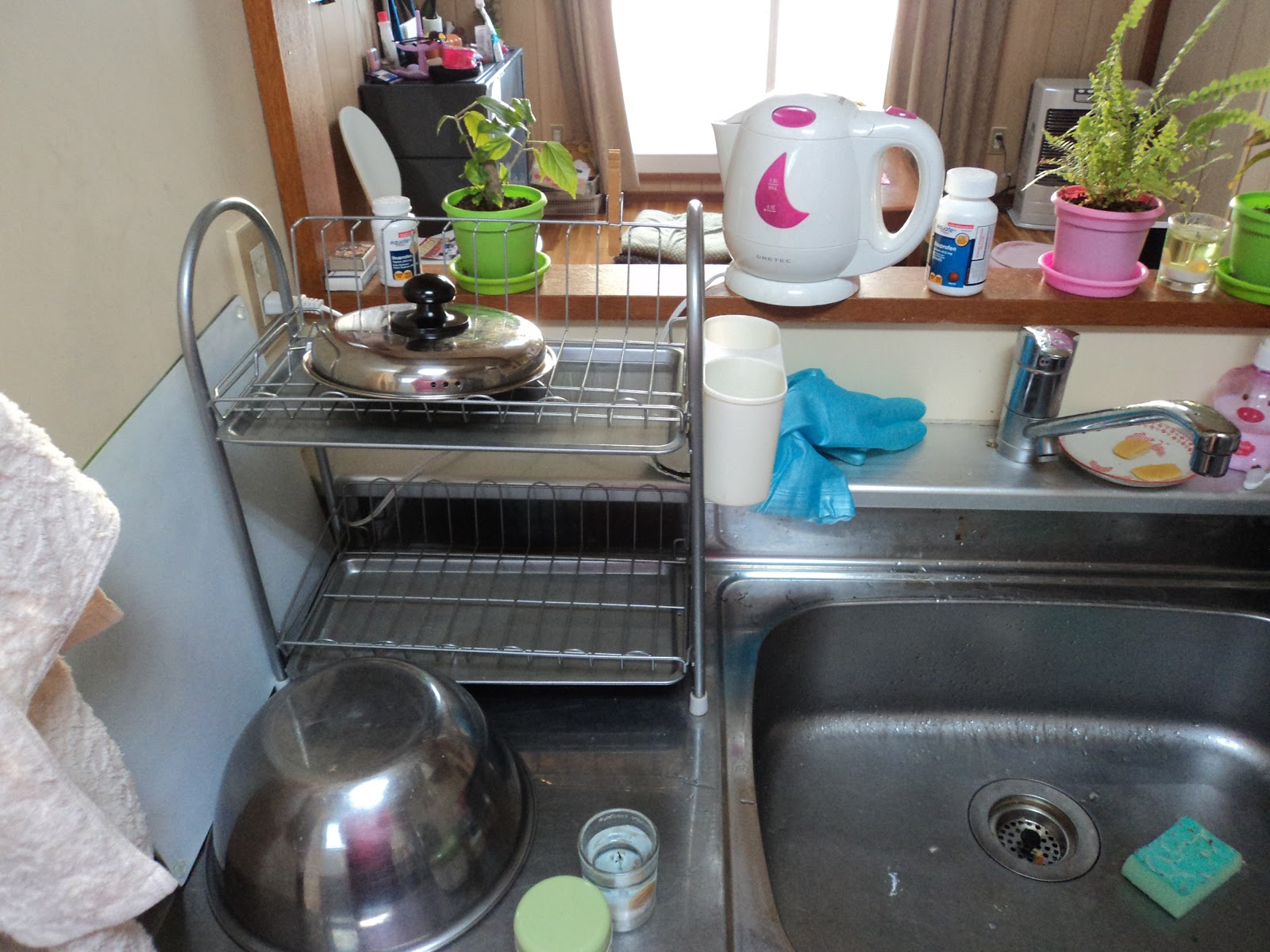
Anna's kitchen is very small and most things in it are small.  Tiny fridge, two burners and a tiny grill space for a stove, and little dish drying rack. Lots of things at the grocery store come in small amounts--1 liter milk, butter in a 1/4 pound size box, salad dressing in little 1 cup size bottles.  There are some things that are bigger--like slices of bread.  You only buy half a loaf but then there are only 4 fat Texas Toast size slices!  And the naganegi onions are like HUGE green onions!


Apple-viegar juice is on the left in the back.  On the right is soy milk.
To make our normal breakfast (eggs, toast, and oatmeal) in Anna's little kitchen first I turn on the gas to the burners.  Then I turn on each burner and put the oatmeal and eggs on to cook.  The toast is made in the little grill under the burners. I have to remove the little grill cover between the burners so the grill gets ventilation.  I put water in the bottom of the grill pan and put the fat toast on the little rack in it.  As the oatmeal and brown eggs with orange yolks are cooking, the bread toasts on the top side.  Then I turn the toast over to brown on the other side. Then I turn off the burners and grill and turn off the gas.  I add some extra flavorful frozen blueberries to the oatmeal and soy milk (since I am in Japan).  I pour apple-vinegar juice in the little cups and we are ready to eat.  The eggs in Japan come in 10 to a case and are always just a day or two old when you buy them.  Each egg is stamped with an expiration date that is a week later.  I think the eggs and blueberries have more flavor here :)

The little drying rack has metal trays to catch water .  Also, Anna has a little automatic hotpot (white with pink on the ledge).  You put water in it, turn on a pink button and it automatically shuts off when it is boiling. The sink has two food catchers--one little one on the top and a deeper one that goes down about 5 inches.

WE SPEND A LOT OF TIME IN ANNA'S APARTMENT
Back os Anna's apartment building.  Her apartment is the last one on the left, second floor.
Outside Anna's kitchen window is a stop light and walk/don't walk light that flashes at night.


Trash has to be separated in Japan,  Anna has separate trash bins for plastics, burnables, paper, glass, and cans.  On different days of the week, a different kind of trash is picked up.
Anna's toilet and bath/shower are right beside each other--but with doors to close each one, of course. Because she just has a curtain between this part of her house and the living area--these areas get heat.

Anna's small entryway.  Japanese use clear umbrellas when it is snowing heavily :)  The area on the left in a Japanese home would have a place for their Buddist worship or a picture of an ancestor that they would offer incense for.
I brought along a Thomas Kinkade puzzle and keep it under our bed when I am not working on it.  I am standing on the tatami mats that make the floor in our room.  Jess lifted one up and they are about 2 inches thick.  

PRESENTING AT KOKSAI JOUHOU KOUKOU
Koksai Jouhou Koukou


  At Anna's school, Jess and I did 3 more class presentations and observed one class giving presentations.  We really enjoyed meeting the students and teachers.  I made a powerpoint with pictures from our home, high school activities in the U.S. (marching band, soccer team,  prom dress, graduation), an American bathroom and kitchen, our work as Christian pastors, and our family life.  After the slideshow, Jess, Anna, and I each got in a group of 13-15 students and had English conversations.   They asked what food we liked in Japan--"gyoza, soba noodles, ramen".  Jess asked them what they thought of a man with a beard--there are no beards in Japan!

Jess teased and told stories--of course :) Some of the groups gave great reactions to the stories and teasing.  We encouraged them to keep speaking English--even if they make mistakes.  After each class, we handed out American candy we had brought with us--cinnamon candy, root beer barrels, and Valentine's Day conversation hearts (because they have English words on them).  Each student said, "Thank you very much!" as they received their candy.
Teacher's room. Anna's desk is straight ahead.  This is where the teachers go when they are not teaching a class.  There are about 80 desks here. Some days Anna only has one class she helps with so she finds lots of things to do at her computer--study Japanese, study the student's names, write emails, etc.

RANDOM THINGS WE SEE IN SAPPORO
Crows are everywhere! CAW! CAW! CAW!


This is how high the snow is this week!

A Japanese barn :) right in the middle of Sapporo!

A beautiful view of the mountains and snow clouds!  This is what they do with their wind shield wipers so they don't get stuck to the windshield.


Saturday, January 12, 2013

Our first few days in Japan

laundry and bath area
A JAPANESE HOME

The room Jess and I slept in at the Bartstch's
Mark and Stephanie live in a fourth story condo that is about 1000 square feet.  Their building is called a mansion.  You enter and take off your shoes before you step up into the house.  It is considered very rude to wear or even set shoes down on the floor in the main part of the house. The entryway has a hall with a door to the bath and a door to the toilet.  The bath and toilet are always in separate rooms.  The bath has a room with a sink and mirror, their washing machine and a door to the bath area. (Most Japanese people do not own dryers.  They hang all their clothes outside to dry on their balconies.)   The bath area has a tile floor and a shower head and bucket, where you wash off BEFORE you climb in the deep and short-in-length tub. The tub is only for soaking.   Off of the main living area there are three rooms used for bedrooms.  Two of these rooms, including ours, have tatami mats.  Tatami (tah-tah-me) mats are closely woven bamboo mats that are uniform in size. You tell the size of the room by how many tatami mats it has.  These two rooms also have the traditional sliding doors with wood "lattice" frames and paper "window panes".  These doors are very beautiful--letting light in but offering privacy.   These doors face the balconies in our room.  Most homes in this southern central area of Japan do not have central heating.  The temperature here is about 30 degrees during the day.  They have gas heaters and a low heated "coffee table" with a blanket that comes down all around it.  You sit with your legs under the table and it is very cozy.  During the night, the heaters are turned off and we have an electric blanket.  The bath, toilet, and entryway are not heated--but they do have a heated toilet seat--which is very helpful!  There are windows on three sides of the condo.  The living area has huge windows with a beautiful view of the cities surrounding us.

THE NEIGHBORHOOD
Stephanie and I at the tea shop in her neighborhood
This part of Japan has continuous cities, one blending into the next, for miles along the coast.  The Osaka, Kobe, Kyoto metropolitan area has 18 millions people.  Ashiya, where we are staying is part of that area.  We can see Osaka, Kobe, Ashiya, and a couple other cities from the window.  We see many apartment buildings and "mansions" in this view from the window.  Most of these are several stories high.  The neighborhood Mark and Stephanie live in is more traditional--meaning is has some of the traditional style wooden homes.  The streets are very narrow and can fit only one car at a time.  Some of the streets are so narrow, they look like they are just for walking--but then a car squeezes by.  I love walking in their neighborhood.  Most people do not own a car--everyone walks and uses public transportation.  On a walk in the neighborhood, you will see old people walking, groups of school children in uniforms coming home from the train, and once in a while, foreigners.  There are lots of little shops, like the tea shop Stephanie and I went to.  There were just three tables to sit at and drink tea.  Mark, Jess, and I also hiked up the mountain from their condo.  We walked to a hiking path and then we were immediately "out" of the city in a semi-tropical forest.  The strenuous hike offered awesome views of the city.

FOOD ADVENTURES
Nabe mono soup
The first night we got here, Mark and Steph had nabe mono soup when we arrived.  There is an almost boiling pot at the table on a burner.  It has seaweed flavored "broth" with cooked cabbage and carrots in it.  Throughout the meal, we added fish, mushrooms, tofu and thinly sliced beef into the soup to cook.    Then you take out what you want to eat and dip it in sesame or soy/citron sauce.  YUMMY!


Noodle soup with sliced pork
at Chinese Restaurant
One evening we went to the Garden mall on the train.  This four story mall has a covered walkway directly from the train station.  There we ate at a Chinese restaurant.  We had dumplings, tofu salad, and Jess and I had noodle soup with sliced pork in it.  This was all very different that the Chinese buffets we have in the US.  At the mall, Stephanie and I enjoyed looking at a kimono store, shopping at a paper store, which had lots of pretty stationary, and looking at the fancy little Japanese dolls for sale for Girls Day, March 3.


English tea and scones.
(Note the golden syrup on the right--
if you ever get a chance--eat some!)
At the little tea shop, Stephanie and I had scones and English tea.  The scones came with clotted cream, jam, and golden syrup (which looks like honey but tastes closer to maple syrup).

Last night we had pounded rice that Stephanie's neighbor had made.  This is a traditional New Year's food.  We used a piece of seaweed (that is flat like paper) to grab the chewy pounded rice ball with soy sauce.  We also had rice balls with sweet bean paste in the center and a fresh strawberry--this is a sweet treat.  Oh, and Mark also made pizza in their little convection/microwave oven.  Japanese do not have traditional ovens.   We enjoyed all of these different tastes.

THE ONSEN
Yesterday we went on the train to the onsen by the bay.  A Japanese onsen is a public bath.  It cost about $10.00 (800 yen) and there is a separate bath for men and for women.  When you enter the bath, you put your clothes in a locker and sit at a little stool with a small bucket and movable shower head.  You complete clean yourself.  Then you are ready to enjoy the relaxing bath area, which includes many different types of soaking tubs and saunas.  Everyone is naked and you used a long narrow hand towel to discreetly cover yourself in between baths.  In the women's bath, there were women with toddlers, old women, middle aged women--everyone enjoying the soothing baths.  I tried  everything--the hot baths, a cold bath that I got in between hot baths, even this spot in one tub where they send a mild electric current through you!  That was the only thing I did not like--that felt freaky!  The Roman sauna was very steamy and my favorite.  There was also a salt sauna where you rubbed salt on the areas of rough skin.
Wedding kimonos at the mall.